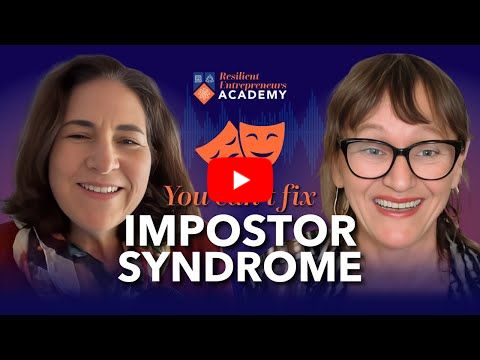
Founder, what if I told you that many top movie actors still battle self-doubt daily, after years at their craft? Filmmaker and Creative Industries Coach Andrea Buck discovered this while interviewing leading actors for a business school initiative - even when at the pinnacle of success, imposter syndrome doesn't disappear.
So what if we don’t fix it?
The truth about imposter syndrome flips everything we've been taught: "The idea of fixing imposter syndrome or fixing self doubt is really quite simple. You can't. Don't bother. Rather, just accept it's part of you. You're human."
Instead of fighting self-doubt, acknowledge it and move forward anyway. When those feelings surface before your next presentation or client pitch, recognise them as evidence you're human, not evidence you're unqualified. Even top-level film producers still feel trepidation every time they step into new territory, but they've learned to say "hello, there you are again, now let's do this!"
Course-correct, don't pivot your vision
When Andrea’s award-winning film "The Jammed" got rejected everywhere - from funding bodies to distribution companies - she didn't abandon the project. Instead, she course-corrected. Like an aeroplane constantly adjusting for wind conditions, her team found alternative routes while keeping their destination in mind.
The film went on to break box office records and spark national conversations about an important issue, human trafficking. The difference between course correcting and pivoting? Course correcting keeps your core vision intact while adjusting your approach. Pivoting may unintentionally abandon the original destination.
When you hit roadblocks in your business, and you will, ask yourself: "Am I getting feedback that I need to change my approach, or am I being told to change my vision?" Your vision might be solid, while your method might need refinement.
Curate your mental diet like your physical health
"You can't be healthy if you don't also consume healthy food" - the same applies to information consumption. In a world where algorithms create echo chambers and AI recycles ideas, protecting your mental space becomes crucial for clear thinking.
Consider treating your information diet with the same intentionality you'd apply to nutrition. You can have occasional "junk" content, but it can't be your primary consumption if you want mental clarity. This means being selective about podcasts, social media feeds, and even news sources that trigger, rather than inform.
The wisdom isn't in isolation, it's in discernment. Be aware of what you feed your mind and who you’re spending most of your time with.
Listen to this complete conversation and the twists and turns of Andrea’s life events - including recovering from a significant brain injury and navigating kindy with a cross-dressing husband!
|
About Andrea Buck
Andrea Buck is a filmmaker, TEDx speaker, and coach specialising in the creative industries. Her film "The Jammed" broke Australian box office records despite universal initial rejection. Through her coaching business Successful Creative, she helps people connect with their inner genius and express it authentically. She also teaches at Compton School, a business school for creative industries at RMIT University, focusing on the personal development aspects of business success.
🎧 Hear or watch Andrea’s full story on this week’s Resilient Entrepreneurs Podcast.
Until next week, founders! Remember, entrepreneurship isn't about having all the answers - it's about backing yourself when the answers aren't clear yet.
If you, like us, love to lean in and keep growing, we'd love to see you at our next free masterclass on Thought-Leadership & Personal Branding.
Vicki Abraham and Laura Ann Bell
Resilient Entrepreneurs Podcast | RE: Women Founders Circle